
22 Oct 2025
Press Release: Last Chance to see rare Magna Cartas at Durham Catheral
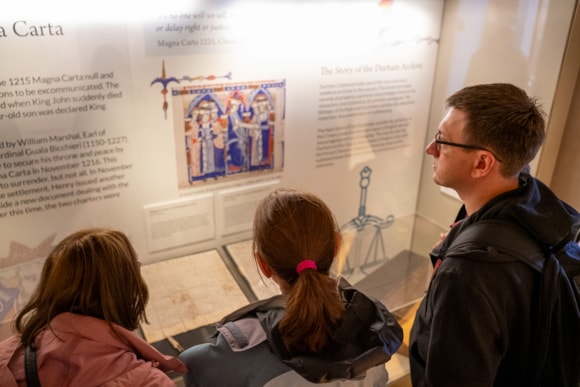
Next week, October half term, marks the last week visitors can see Magna Carta and the North at Durham Cathedral, with the final day of the installation on Sunday 2 November.
Visitors have just less than 10 days to view the only surviving 1216 Magna Carta, alongside issues from 1225 and 1300, and three Forest Charters in Durham Cathedral Museum - a rare opportunity which visitors are urged 'not to miss'.
Andrew Usher, Chief Officer: Visitor Experience and Enterprise at Durham Cathedral says,
“Due to their fragile nature and historical importance, these documents are rarely out on display. It will likely be another 8 years or more before they can be shown again to the public. We encourage anyone who was planning to see them to book a Museum ticket soon so they dont miss out."
The last time the Magna Cartas and the Forest Charters were on display at Durham Cathedral was in the summer of 2017 when almost 19,000 people came to see them over an 11-week period.
Since the exhibition opened on 11 July, the Museum has seen a third more visitors (over 25,000) compared to 2017, with thousands more visiting the cathedral itself and seeing the supporting art installations that form part of the wider Magna Carta and The North exhibition.
Part of the exhibition is The Words That Bind Us, a light-based art installation by Nicola Anthony, which creates a 'river of words' in the cathedral’s Nave. During the last week of the exhibition, which coincides with the October school holidays, visitors can take inspiration from the artwork, craft a fish with a hidden message and move it through the light. In addition, families can pick up a free Magna Carta and the North activity leaflet and take advantage of the 'Kids Eat Free' offer in the Undercroft Cafe.
Andrew continues,
"Not only are we displaying extraordinary documents that are over 800 years old, we're also bringing them to life through contemporary artworks and activities for all ages to show how they remain enduring symbols of social justice in the world today."
When visitors have been asked for their view of the exhibition, Kathryn from Bourton-on-the-Water gave a compelling statement,
“Every child should see the Magna Carta exhibition, its mind blowing. A real sense of our history.”
Magna Carta and The North forms a powerful narrative, one that bridges centuries and cultures, inviting reflection on justice, equality, and the shared human experience. You can see Magna Carta and the North at Durham Cathedral until Sunday 2 November 2025.
For more information visit: www.durhamcathedral.co.uk/magnacarta
Contact Information
Clare Knowles
Head of Marketing & Digital
Durham Cathedral
clare.knowles@durhamcathedral.co.uk
Notes to editors
Please get in touch if you would like further information or images
Magna Carta, or the ‘Great Charter’, has been described as the most famous document in English history and a cornerstone of modern democracy. First issued in 1215, it was the first document that put into writing that the king and his government were not above the law, in order to prevent the king from exploiting his power. With three clauses from the 1225 Magna Carta still in force today, the document remains a cornerstone of British democracy.
Durham Cathedral is a Christian Church of the Anglican Communion, the shrine of St Cuthbert, the seat of the Bishop of Durham and a focus of pilgrimage and spirituality in North East England. It inhabits a treasured sacred space set in the natural and human landscape of the World Heritage Site.
Its purpose is to worship God, share the gospel of Jesus Christ, welcome all who come, celebrate and pass on its rich Christian heritage and discover its place in God’s creation.
The building of Durham Cathedral commenced in 1093 and took around 40 years to complete. It replaced a Saxon cathedral built by the Community of St Cuthbert after it arrived in Durham in 995 following its flight from the ‘Holy Island’ of Lindisfarne 80 miles North of Durham. The body of St Cuthbert is enshrined in the Feretory at Durham Cathedral and the Tomb of the Venerable Bede is in The Galilee Chapel. The Cathedral existed as a Benedictine Monastery until 1539 when it became one of the Church of England’s major Cathedrals.
It continues to be a focus for pilgrimage and attracts visitors from all over the world. The Cathedral has internationally important collections of artefacts, manuscripts and books that include St Cuthbert’s coffin and his pectoral cross; superb examples of Anglo-Saxon craftsmanship. Durham Cathedral is often referred to as the best example of Romanesque architecture in Europe, or as American writer Bill Bryson put it, ‘the best Cathedral on planet earth.’
Since its construction Durham Cathedral has been alive with people and a centre for community activity. The Cathedral is home to a vibrant worshipping community and continues to celebrate the English Choral Tradition with sung services by its highly acclaimed Choir. As a new century unfolds Durham Cathedral aspires to enrich the many different ways in which it engages with people and organisations. It is cherished equally by those who live, work and study in the region and by those who come to visit.
Find more information at www.durhamcathedral.co.uk
Downloads


Powered by Onclusive PR Manager © 2026